
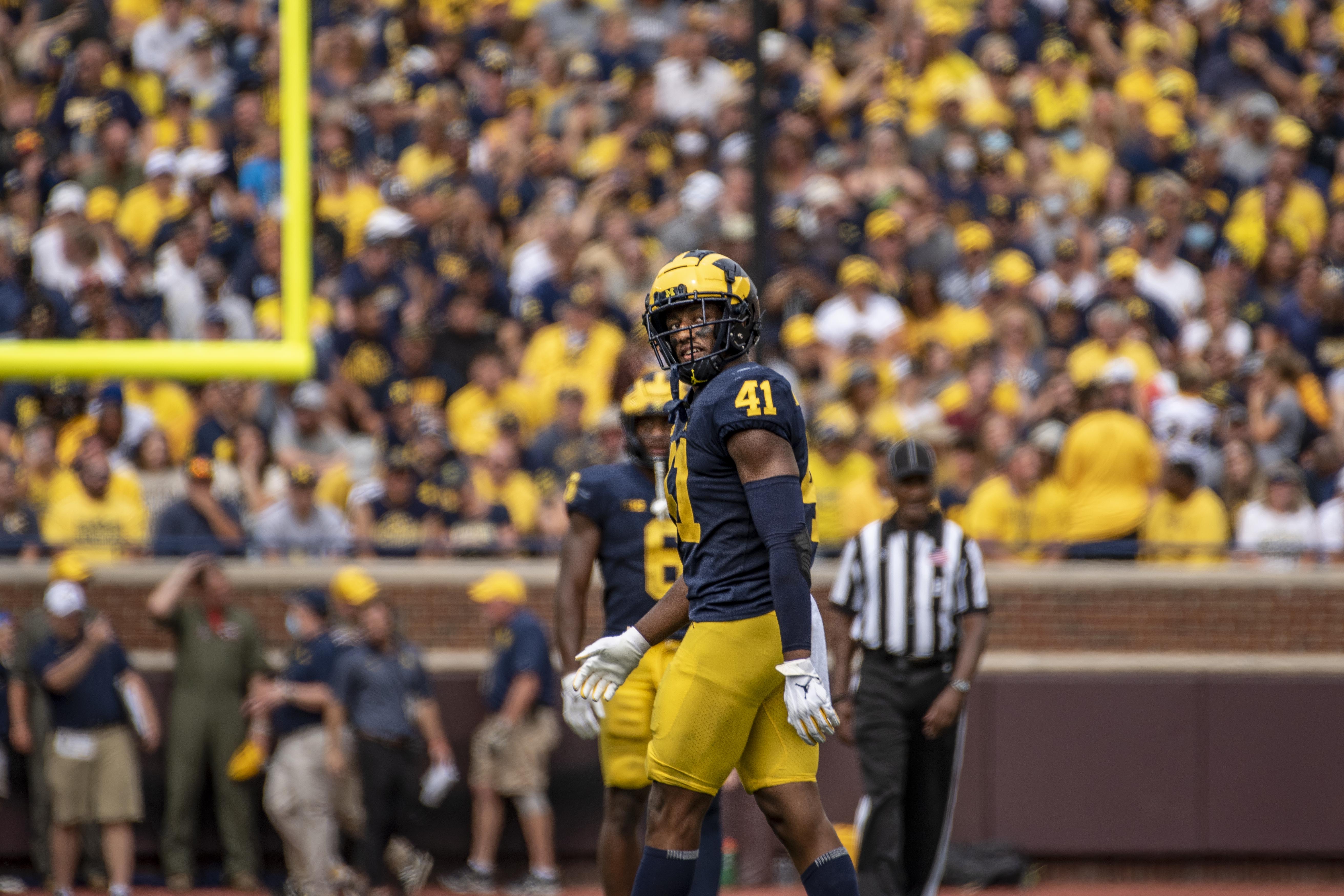
As college football season gets into full swing, Jaiyson Lewis examines how players are navigating the opportunities and risks that come with the transfer portal.

A name appears on the screen, and the room shifts just slightly.
Inside the University of Pittsburgh’s football facility, the noise never really stops. Weights crash, music pulses through the speakers. But in between reps, players glance down at their phones. A post. A notification. Another athlete has entered the transfer portal.
No one announces it, but everyone notices.
For Raion Strader, those moments have become part of the routine.
The 6’0” defensive back from Pittsburgh, Pennsylvania, a former Miami (Ohio) player, entered the transfer portal in 2024 and is now a member of the Pittsburgh Panthers.
“You see it and it just kind of hits you,” Strader said. “Like, okay… things are moving again.”
A System That Changed Everything
The NCAA transfer portal, introduced in 2018 as a tool for transparency, has evolved into one of the most powerful forces in college athletics.
The numbers tell the story.
According to the National Collegiate Athletic Association (NCAA), from 2020 to 2025, the number of football players entering the portal increased by 418%, rising from 786 to more than 4,000. Across all Division I sports, more than 20,000 athletes entered the portal in a recent cycle. In football, roughly one in four players transfers annually. In men’s basketball, that number approaches one in three.
Add in recent rule changes allowing unlimited transfers and the rapid rise of Name, Image, and Likeness (NIL) compensation, and the system begins to resemble something closer to professional free agency.
What was once a limited pathway for athletes seeking new opportunities has become a defining feature of modern college sports. The transfer portal now sits at the center of a rapidly evolving system, one driven by mobility, money, and immediate performance. For athletes, it offers unprecedented control. For programs, it creates constant instability.
“You’re Always Evaluating”
For players, the biggest change is not just movement, it’s mindset.
“You’re always evaluating,” Strader said. “Even if you’re not thinking about leaving, you’re thinking about your role, your future, how things are going to play out.”
That constant awareness has changed how athletes approach their careers. Tamere Robinson understands how quickly things can shift. A Pittsburgh native, Robinson began his career at Penn State before transferring to USC. He described the decision as both an opportunity and a risk.
“It’s not just football anymore,” Robinson said. “It’s your career. You’ve got people talking to you, you’ve got options, and you’ve got to figure out what’s real.”
He said the pressure comes from knowing there are no guarantees.
“You’re making a decision that can change everything,” Robinson said. “If you get it right, it can help you. If you don’t, it can set you back.”
The Money Factor
The rise of NIL has added another layer to those decisions. Transfer players can command significantly higher deals. According to estimates from college sports recruiting and NIL media company On3’s NIL 100, the market value of top college athletes ranges from $1.5 million to $6.5 million.
“It would be naive to say money isn’t part of it,” said Daemar Kelly, a college basketball player now at Northern Illinois after transferring from Quinnipiac and Saint Francis. “It’s part of every decision now.”
But Kelly emphasized that financial opportunity alone does not determine success.
“If you’re not in the right situation, it doesn’t matter what the deal looks like,” he said. “You still have to perform.”
That reality has created a new kind of pressure tied not only to playing time, but to value.
“You’ve got to prove why you’re worth it,” Kelly said.
Coaches Caught in the Middle
For coaches, the portal has fundamentally changed how teams are built and maintained.
Erik Taylor, a player development coach at Rutgers University, said the shift has forced programs to rethink everything from recruiting to retention.
“It’s a completely different environment than it was even a few years ago,” Taylor said. “You’re not just developing players, you’re constantly managing relationships, expectations, and opportunities.”
Taylor said the portal has created a year-round cycle.
“There’s no real downtime,” he said. “You’re recruiting high school players, evaluating the portal, and making sure your current guys feel valued and supported.”
That balancing act can be difficult.
“You want to build something long-term,” Taylor said. “But at the same time, you have to be ready to adjust quickly. That’s the challenge.”
While coaches manage the day-to-day impact of roster movement, administrators are tasked with navigating the broader structure of the new system.
Reyna Gilbert Lowry, Executive Associate Athletic Director at the University of Virginia, said the transfer portal and NIL have reshaped college athletics at every level, not just on the field, but across entire athletic departments.
“The portal and NIL didn’t just change recruiting, they changed the entire ecosystem,” Lowry said. “We’re now operating in a space where athlete movement, financial opportunities, and institutional strategy are all connected.”
Lowry said one of the biggest challenges is balancing athlete empowerment with long-term program stability.
“You want student-athletes to have opportunities and agency that’s important,” she said. “But there also has to be structure to support them through those decisions, because not every outcome is guaranteed.”
She emphasized that NIL has added both opportunity and complexity to the transfer process.
“NIL has created meaningful opportunities for student-athletes, but it’s also introduced new pressures,” Lowry said. “Decisions are happening faster, with more at stake, and that requires education and transparency.”
The Other Side of Opportunity
For all the movement and opportunity, the portal carries real risk. Each year, thousands of athletes enter without finding a new team.
“That’s the part people don’t talk about enough,” Taylor said. “There are a lot of young men who enter the portal thinking something better is guaranteed, and that’s not always the case.”
Players feel that uncertainty, too.
Nikhai Hill-Green, a Pittsburgh native and former Alabama linebacker preparing for the 2026 NFL Draft, said awareness of that risk has grown among players.
“Everybody sees the good side,” Hill-Green said. “But there’s another side to it. Not every move works out.”
That reality forces players to think more strategically than ever before.
“You’ve got to have a plan,” he said.
Free Agency Or Fairness?
As the system continues to evolve, opinions remain divided. Critics argue the transfer portal has created instability, turning college sports into what some describe as unregulated free agency. Constant roster turnover can disrupt team chemistry and shift focus away from long-term development. Supporters argue the system is simply correcting an imbalance.
“For a long time, players didn’t have much control,” Strader said. “Now they do.”
That tension between empowerment and uncertainty defines the current era.
What Comes Next
The financial stakes are only expected to increase. New revenue-sharing policies will allow schools to distribute up to $20.5 million annually to athletes, with projections suggesting that number will continue to rise. The shift signals a future where college athletics more closely resembles a professional model.
But questions remain. How will programs maintain stability? What protections will be in place for athletes who enter the portal without options? And how will the system evolve as money continues to grow?
In today’s college football landscape, the noise never really stops and neither do the decisions waiting just outside the weight room.
“If you wanna be great, sometimes you got to take risk. Risk equals award,” Strader said.
Leave a Reply